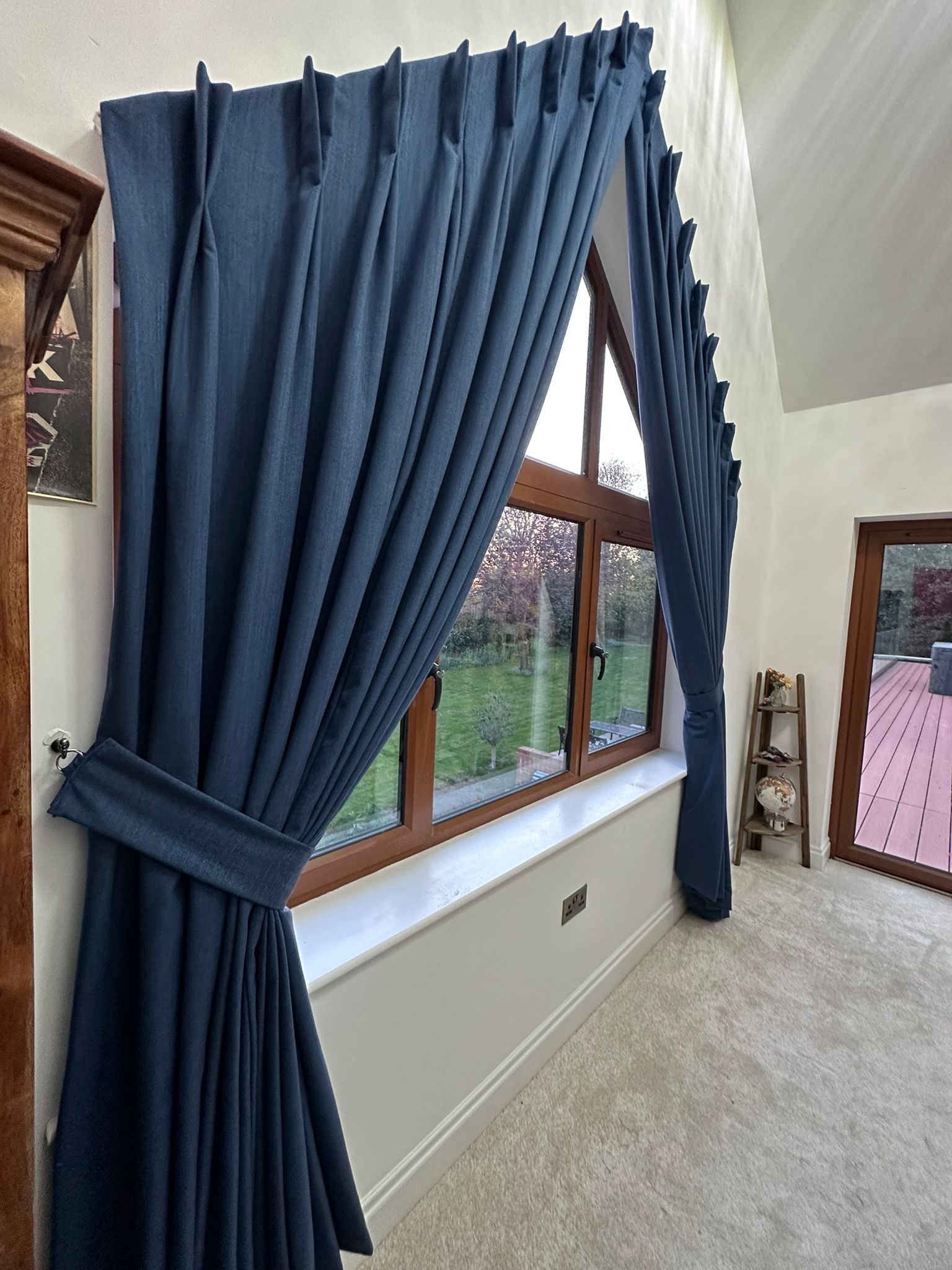
Unlike standard rectangular windows, apex windows have angles, uneven drops, high fixing points and unusual proportions. This means the curtains cannot usually be made using standard methods. Every detail has to be measured, planned and made carefully so the final result looks elegant rather than awkward.
For many homeowners, the challenge is not just finding curtains that fit. It is finding curtains that look balanced, hang properly and work with the shape of the room.
## Why Apex Windows Are Difficult to Dress
A standard curtain is usually made for a straight track or pole. The width is measured, the drop is measured, and the curtain hangs vertically from the top.
An apex window is different.
The top of the window rises to a point or angle, often following the roofline. This means the curtain track may need to follow the slope of the window rather than running straight across. As a result, each section of the curtain can have a different drop length.
One side may be short. The centre may be much taller. The other side may fall at a completely different angle. On very large apex windows, the difference between the shortest and longest drop can be dramatic.
This creates several challenges:
The curtain must follow the window shape.
The fabric must hang neatly despite the angle.
The fullness must look even.
The heading must sit correctly on a sloped track.
The curtain must not twist, pull or collapse.
The finished result must look intentional and elegant.
This is why apex curtains need specialist knowledge. They are not just normal curtains made taller. They are a completely different type of curtain project.
## Measuring Is the Most Important Stage
With apex curtains, accurate measuring is everything.
On a normal window, being slightly out by a small amount may not ruin the entire job. On an apex window, a small measuring mistake can affect the whole curtain shape.
The maker needs to understand the full geometry of the window. That includes the width, the highest point, the shortest point, the angle of the slope, the position of the track and the finished drop to the floor or sill.
For full-length apex curtains, the floor level also matters. Many homes are not perfectly level, especially barn conversions or older properties. If the curtain is made to the wrong floor point, one section may touch the floor while another section hangs too short.
This is why professional measuring is strongly recommended for apex curtains. A customer measurement may be enough for a standard bedroom window, but with apex windows, site measuring is usually the safest option.
The fitter or curtain specialist needs to assess:
The exact window shape.
The fixing surface.
The height of the apex.
The type of wall or ceiling.
The floor level.
Any radiators, furniture or obstructions.
Whether access equipment is needed.
The way the curtains will be used.
Without this information, it is very easy to make a curtain that technically covers the window but does not look right when installed.
## The Angle Changes Everything
The biggest difference with apex windows is the angle.
A curtain hanging from a flat horizontal track falls naturally downwards. Gravity does the work. But on an angled track, the curtain is being suspended from a sloped line. This affects how the fabric gathers, how the pleats sit and how the curtain weight is distributed.
On a sloped track, the curtain does not behave the same way as it does on a straight track. The fabric may want to slide downwards. The heading can become uneven. The pleats can lean. The curtain may not stack neatly.
This is one reason why many apex curtain designs are made as fixed or semi-fixed curtains. Instead of being drawn open and closed like normal curtains, they are often dressed into position and held with tiebacks.
This approach can look very elegant when done properly. The curtains frame the window, soften the room and create the appearance of a luxurious made-to-measure finish. However, the customer must understand that many apex curtain designs do not move across the track in the same way as standard curtains.
Good communication is essential. The customer needs to know whether the curtains will be decorative, functional, fixed, tied back, or designed for limited movement.
## Choosing the Right Heading
Curtain heading choice is very important for apex windows.
Some headings work better than others depending on the angle, the track type and the desired look.
### Pencil Pleat
Pencil pleat is often used for apex curtains because it can be adjusted and dressed into position. It works well for fixed or tied-back arrangements and can suit angled tracks when made carefully.
It is a practical and flexible choice, especially when the priority is to frame the window rather than draw the curtains open and closed every day.
### Pinch Pleat
Pinch pleat gives a more tailored and luxurious look. It creates structured folds and a smarter finish. However, it needs careful planning on apex windows because the pleats must sit correctly along the angled line.
Pinch pleat curtains can look stunning on apex windows, but they must be made with precision. The spacing, fullness and drop lengths need to be carefully calculated so the final result looks balanced.
### Wave Curtains
Wave curtains are popular for modern interiors, but they can be more complicated on apex windows. Wave headings depend on consistent spacing and smooth movement along a track. On angled or irregular tracks, this can be difficult.
Wave may work in some apex situations, especially on straight lower sections or specially designed layouts, but it is not always the best option for steeply angled windows.
### Eyelet Curtains
Eyelet curtains are generally less suitable for apex windows because they require a pole and usually depend on a straight horizontal fixing. They are not designed to follow angled tracks in the same way.
For most apex projects, specialist track-based headings are a better option.
## Track Design and Fixing Challenges
The curtain track is one of the most important parts of an apex curtain installation.
A standard straight track is not enough for most apex windows. The track may need to be angled, bent, joined or custom fitted to follow the window line.
The fixing surface also has to be considered. Some apex windows sit inside plastered reveals. Others are surrounded by timber frames, steel beams, vaulted ceilings or plasterboard with limited fixing strength.
The fitter needs to know whether the surface can safely hold the curtain weight. Large apex curtains can be heavy, especially when using lined or blackout fabrics. If the track is not fixed properly, the installation may fail over time.
Track planning must consider:
The angle of the window.
The weight of the fabric.
The number of curtain sections.
The position of brackets.
Whether the track will be visible.
How the curtains will stack.
Whether tiebacks are needed.
Whether access equipment is required for fitting.
On very high apex windows, fitting can also require ladders, towers or scaffold access. This adds time, cost and planning to the project.
## Fabric Choice Matters
Not every fabric behaves well on an apex window.
Some fabrics are too stiff. Some are too thin. Some show every irregularity. Others are so heavy that they put too much strain on the track.
The fabric needs to drape well and hold its shape. It should have enough body to look luxurious but not be so heavy that it becomes difficult to manage.
For apex curtains, the fabric choice affects:
How the folds hang.
How the curtain dresses to the side.
How much fullness is needed.
Whether the curtain looks bulky.
Whether the heading stays neat.
How much weight the track must carry.
Lining also matters. Blackout lining, thermal lining and interlining all add weight. They can improve comfort and privacy, but they must be allowed for in the design and installation.
A dark fabric such as navy blue, charcoal or deep green can look very striking on an apex window, but darker colours often make the shape and folds more noticeable. This means the making and dressing must be especially neat.
## Fullness and Balance
Curtain fullness is another major challenge.
A curtain needs extra fabric to create folds. On standard curtains, fullness is easier to calculate because the top line is straight. On apex curtains, the angled shape means the fabric distribution can feel different from one side to the other.
If there is too little fullness, the curtains can look flat and unfinished. If there is too much fullness, they can look bulky, especially at the shorter sides.
The goal is to create balance.
This is not just a mathematical calculation. It is also a design judgement. The maker needs to understand how the fabric will behave once it is hanging, how it will gather at the sides and how the finished folds will look from across the room.
This is where experience makes a big difference.
## Different Drop Lengths
One of the hardest parts of making apex curtains is managing different drop lengths.
A single curtain may need to be cut so that the top follows an angle while the bottom finishes neatly at the floor. This is not the same as making a normal rectangular curtain.
If the curtain is not cut correctly, the bottom can look uneven. The folds may pull at different points. The curtain may appear twisted or distorted.
For large apex windows, the maker may need to create separate curtain sections, especially if the centre drop is much longer than the sides.
In some cases, a four-panel design may be better than a simple pair. This can help manage extreme height differences and create a more balanced look.
The design depends on the window proportions. A shallow apex may suit a simpler layout. A very steep apex may need a more advanced arrangement.
## Function Versus Appearance
One of the biggest conversations with apex curtains is whether the curtains are mainly for appearance or for daily use.
Many customers want the curtains to open and close like normal curtains. Sometimes this is possible. Sometimes it is not practical.
The more angled and complex the window, the harder it becomes to create a fully moving curtain system. Sloped tracks, fabric weight and high fixing points can limit movement.
For this reason, many apex curtains are designed to be:
Fixed in position.
Dressed to the sides.
Held with tiebacks.
Used mainly as a decorative frame.
Combined with blinds for privacy.
Made as separate panels for easier control.
This does not mean the curtains are less valuable. In many apex rooms, the main purpose is to soften the architecture, add luxury and make the room feel finished. The curtains create warmth and style even if they are not opened and closed every day.
The important thing is to be honest at the design stage. A good apex curtain specialist will explain what is realistic before the curtains are made.
## Access and Installation
Apex windows are often high. Some reach into vaulted ceilings or double-height spaces. This makes installation more complicated than a normal curtain job.
The installer may need specialist ladders, scaffold towers or access equipment. The room may need to be cleared. The floor surface must be safe. There may be staircases, beams or furniture in the way.
Access affects:
How the track is fitted.
How safely the fitter can work.
How long the installation takes.
Whether extra equipment is needed.
The final installation cost.
This is why photographs and measurements are helpful at the enquiry stage, but a proper survey may still be needed before confirming the final design.
## Why Bespoke Making Is Essential
Ready-made curtains are not suitable for most apex windows.
They are made for standard straight windows and fixed drops. Apex windows require custom measurements, custom cutting, custom heading work and specialist installation.
Bespoke apex curtains allow the curtain to be made around the exact window shape. This gives a much better finish and avoids the common problems of poor fit, uneven drops and awkward fabric gathering.
A bespoke service can also consider the room as a whole, including colour, fabric texture, lining, privacy, light control and the overall interior style.
For a feature window, this matters. Apex windows are usually a major part of the room’s architecture. Poorly fitted curtains can spoil the look. Well-made curtains can transform it.
## Common Mistakes With Apex Curtains
Some common mistakes include:
Using a standard curtain design on a non-standard window.
Measuring only the width and tallest drop.
Ignoring the shortest drop.
Choosing a heading that does not suit the angle.
Assuming the curtains will move like normal curtains.
Using fabric that is too heavy for the track.
Not allowing for lining weight.
Not planning access for installation.
Forgetting how the curtains will stack at the sides.
Not explaining fixed or tied-back designs clearly to the customer.
These mistakes can lead to expensive problems. With apex curtains, it is much better to plan properly at the beginning than try to correct issues later.
## What Makes a Good Apex Curtain Installation?
A successful apex curtain installation should look natural, balanced and intentional.
The curtains should follow the shape of the window without looking forced. The folds should hang neatly. The fabric should feel appropriate for the room. The heading should look controlled. The track should be secure. The finished result should enhance the architecture rather than fight against it.
The best apex curtains do more than cover glass. They turn a difficult window into a design feature.
They add softness to hard architectural lines. They create warmth in rooms with high ceilings. They improve privacy and comfort. They give the space a complete, premium feel.
## Final Thoughts
Making curtains for apex windows is challenging because every project is different. The angles, drops, height, fabric, track and room layout all affect the final design.
There is no one-size-fits-all solution.
Apex curtains require careful measuring, specialist making, thoughtful fabric choice and experienced installation. When done properly, they can completely transform a room and make an unusual window feel elegant, balanced and beautifully finished.
For homeowners with apex, triangular or gable end windows, the key is to work with someone who understands the challenge. These windows need more than standard curtains. They need a tailored solution designed around the architecture itself.
General
The Challenge of Making Curtains for Apex Windows
Unlike standard rectangular windows, apex windows have angles, uneven drops, high fixing points and unusual proportions. This means the curtains cannot usually be made using standard methods. Every detail has to be measured, planned and made carefully so the final result looks elegant rather than awkward. For many homeowners, the challenge is not just finding curtains that fit. It is finding curtains that look balanced, hang properly and work with the shape of the room.
Explore Solutions
Explore curtain solutions by window type
Related Guides
Continue reading
Need tailored advice?
Have a similar window in your home?
Start your curtain journey, upload a photo of your window and get advice tailored to your space.