Before you order / A practical buying guide
Buying apex curtains online? Know the whole picture.
Ordering curtains online can work well when the measurements, product and installation are understood. A shaped window asks more of each decision. The important comparison is the cost and responsibility of the complete, fitted result.
Explore the details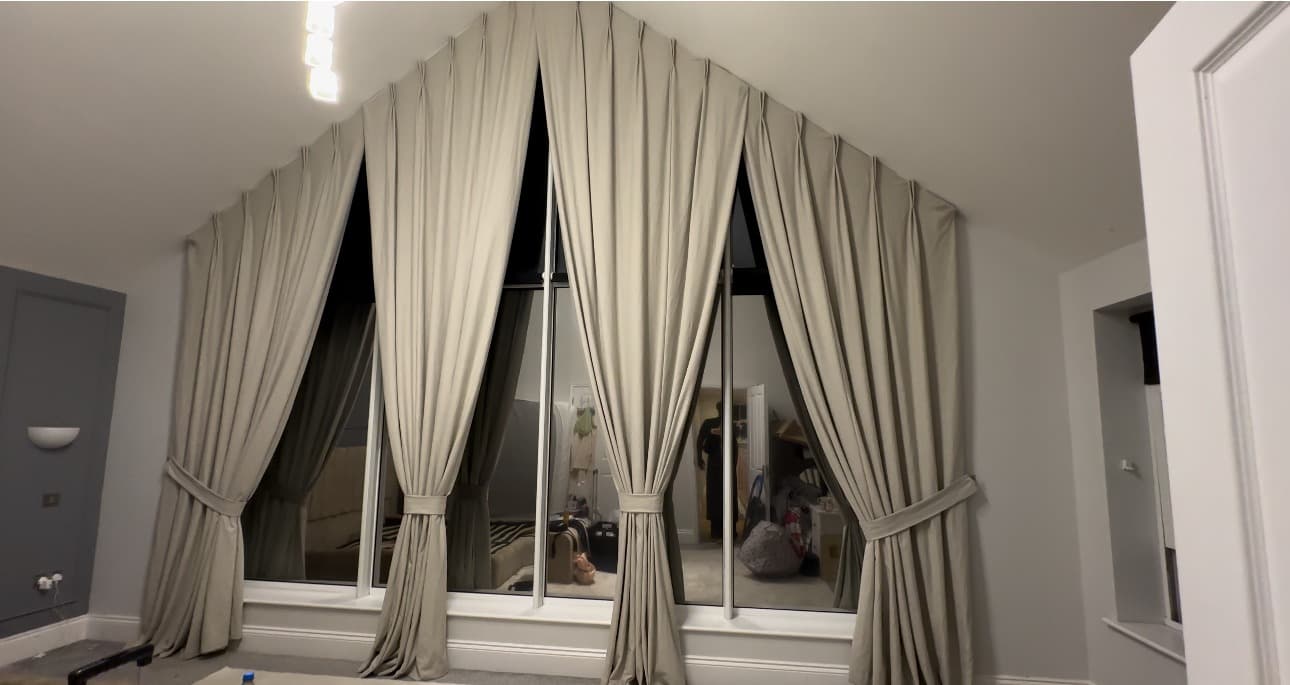
01 / The details
A normal rectangular window is forgiving. An apex window isn’t.
That is a useful starting point, although every installation has limits. On some rectangular curtains a small adjustment at the hooks or hem can absorb a modest measuring difference. Even a 10–20 mm error is not always harmless, and on a sloping installation it can affect the whole line of the heading, track or lower edge.
An apex curtain is a shaped piece of cloth made to relate to a specific track route. Measure to the wrong reference point, omit the true roof angle or assume both sides are symmetrical and the error can run through several panels. The ceiling, glazing and proposed track may not share the same line.
A photograph and rough dimensions are useful for an initial discussion. They are not a substitute for checking the actual slopes, changes in plane, high and low drops, floor level, fixing positions and the selected heading before manufacture.
02 / The details
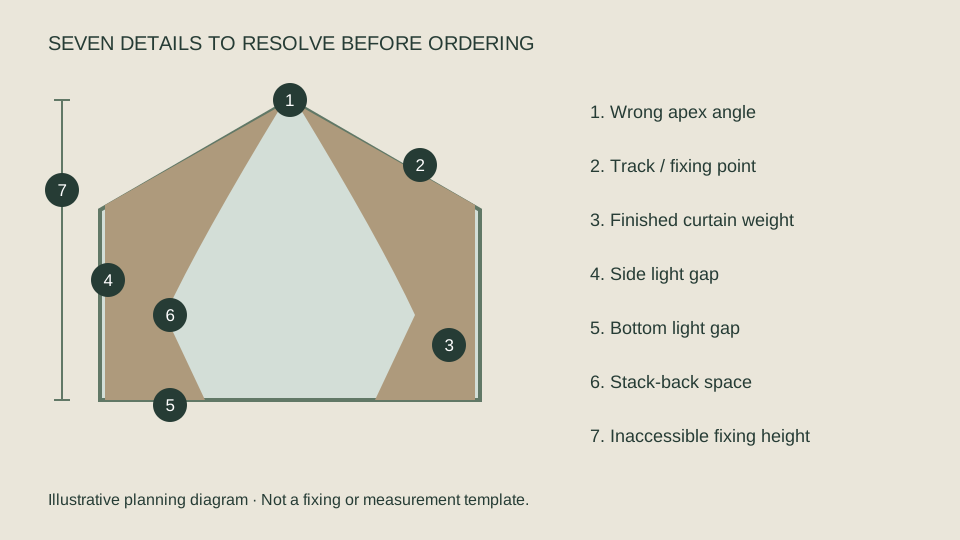
Where DIY apex installations can go wrong
These are failure points to assess, not a prediction that every self-installed curtain will fail. A competent installer with a verified design and suitable equipment may achieve a good result. The risk grows when measurement, track supply, curtain making and fitting are treated as unrelated purchases.
| Decision | What can be missed | Possible consequence |
|---|---|---|
| Geometry | Wrong measuring points, angle or assumed symmetry | A heading that does not follow the track; unequal or short drops |
| Track and heading | Finished lined weight, carrier compatibility and operation on a slope | Poor movement, unsupported load or an incompatible heading |
| Fixings | Weak substrate, missing backing or unsuitable brackets | Loose supports, remedial building work or an unsafe installation |
| Stack-back | The bulk and resting position of the open curtain | More glass covered than expected; restricted doors or handles |
| Light control | Gaps above, beside, between and below panels | Correct blackout cloth but a room that remains brighter than expected |
| Access and finish | Working height, handling, dressing and hook position | An impractical fitting visit or an uneven finished appearance |
03 / The details
The curtain is heavier than the sample
The track carries the made curtain: face cloth, lining, fullness, seams and any interlining. A long gable curtain can contain a substantial area of fabric. Choosing a rail from its length or appearance alone can miss the finished load and the concentration of weight where the curtains gather.
The rail rating does not establish what the ceiling can carry. Plasterboard, timber, masonry and steel need different fixing decisions. Fixing into an unverified surface or relying on a decorative lining can leave the installation dependent on a weak point. Heavy curtains may need backing or structural assessment before the track is fitted.
The heading must also suit the carriers and route. A beautiful wave or pleated curtain cannot correct an incompatible track arrangement. Confirm the heading, fullness, hooks, retained sections and intended movement as one specification.
04 / The details
Fitting the opening is only part of the result
A curtain may reach the track yet finish too short at the floor. On a tall window, measuring from the wrong point at the heading or ignoring a changing floor level can make that error conspicuous. A shaped panel may not have enough spare fabric to lengthen it without altering its proportions.
An open curtain needs somewhere to go. If stack-back or the tieback sweep has not been planned, fabric can remain over more of the glass than expected. On a slope, retained sections may mean the upper glazing is never completely clear.
Blackout lining can be correctly made and still leave light around the installation. Track projection, side returns, centre overlap and hem clearance are separate from the lining’s performance. Floor-length curtains can reduce a bottom gap but cannot promise a sealed room.
Finally, the cloth needs dressing. Uneven folds, twisted layers or an over-tight tieback can make an otherwise fitting curtain look unresolved. A final check should consider the room from normal viewing positions, both open and closed.
05 / The details
Can the installation be reached safely?
Reaching a fixing briefly is different from working there while drilling, aligning a track and handling a heavy curtain. Very high windows can be unsuitable for ordinary ladder access, depending on the task, duration, floor and space. Furniture is not a substitute for access equipment.
A suitable tower such as MiTOWER may be an option, but only within its approved configuration and with adequate floor support and stabiliser space. Some rooms require a different method. Plan the access, delivery route and handling before ordering; a fitter arriving to an inaccessible peak cannot solve that problem with curtain adjustments.
06 / The details
The hidden cost of buying twice
A lower product price may still be good value when the specification and fitting are right. It becomes harder to compare when the quotation excludes the work needed to achieve the finished result. Ask what happens if the dimensions, track or site conditions prove wrong.
Made-to-measure curtains are cut to an agreed shape. There may be little tolerance for changing an angle, increasing a drop or adding fullness afterwards. Some alterations are possible; others require new panels or a remake. Do not assume an independent fitter will accept responsibility for measurements or products supplied by someone else. Agree their scope and availability before purchase.
- A replacement track or compatible carriers and brackets.
- Alterations, additional fabric or replacement curtains.
- A separate fitting visit, including a return visit if parts are wrong.
- Tower or other access-equipment provision and setup.
- Remedial backing, fixing work or making good.
07 / The details
One considered route from survey to aftercare
Apex’s process brings the decisions together: survey → assess the fixing surface → measure the geometry → decide the track → calculate the curtain requirements → manufacture → professional installation with suitable access → dress the curtains → final checks → aftercare.
The benefit is coordination. The curtain maker works from the agreed track and heading, the installer understands the intended operation, and access is considered before the fitting day. The quotation should make the agreed scope and any building or access work clear; specialist support does not remove the need to resolve unexpected site conditions.
| Stage | Self-managed purchase | Apex project process |
|---|---|---|
| Before manufacture | You coordinate measurement, specification and acceptance with the suppliers | Survey, geometry, fixing context and curtain specification considered together |
| Fitting | You arrange a competent fitter and suitable access, with responsibilities agreed | Installation planned around the agreed system and site |
| Completion | You arrange dressing, adjustments and ongoing support | Dressing, demonstration, final checks and care guidance form part of the handover |
08 / The details
See complex windows resolved in real rooms
The Milton Keynes project records an apex master bedroom with wave pleat curtains and a bespoke track. The Cambridge gable-end bedroom records pinch pleat curtains and blackout lining. They illustrate why geometry, heading and light control belong in the same design conversation.
These are completed-project examples, not claims that either customer experienced a failed DIY installation. We do not attribute a mistake to a customer or another supplier without evidence. Use the photographs and recorded specifications to assess the kind of window involved, then discuss the differences in your own room.
A little more clarity
Your questions, answered
Does every DIY apex curtain installation fail?
No. A well-specified system, accurate measurement, competent fitting and suitable access can work. The difficulty is coordinating those parts on a window with changing angles and drops.
Can an incorrectly made apex curtain always be altered?
No. Some adjustments may be possible, but an incorrect angle, insufficient drop or missing fullness can require new panels. The available fabric and construction determine what can be changed.
Should I book a fitter before ordering online curtains?
Yes. Agree who checks measurements, accepts the specification, provides access and takes responsibility for each part before placing the order.
Made around your home
Let’s find the right finish
for your window.
A photograph, the shape of the room and the way you want it to feel. That’s where we begin.
Discuss your curtains Or call 0800 772 0367