The curtain collection / Tiebacks
Curtain tiebacks. A considered gesture.
A tieback changes more than the outline of a curtain. It reveals the view, brings depth to the folds and can introduce a quiet note of colour. On a shaped window, it is part of the design from the beginning.
Explore the details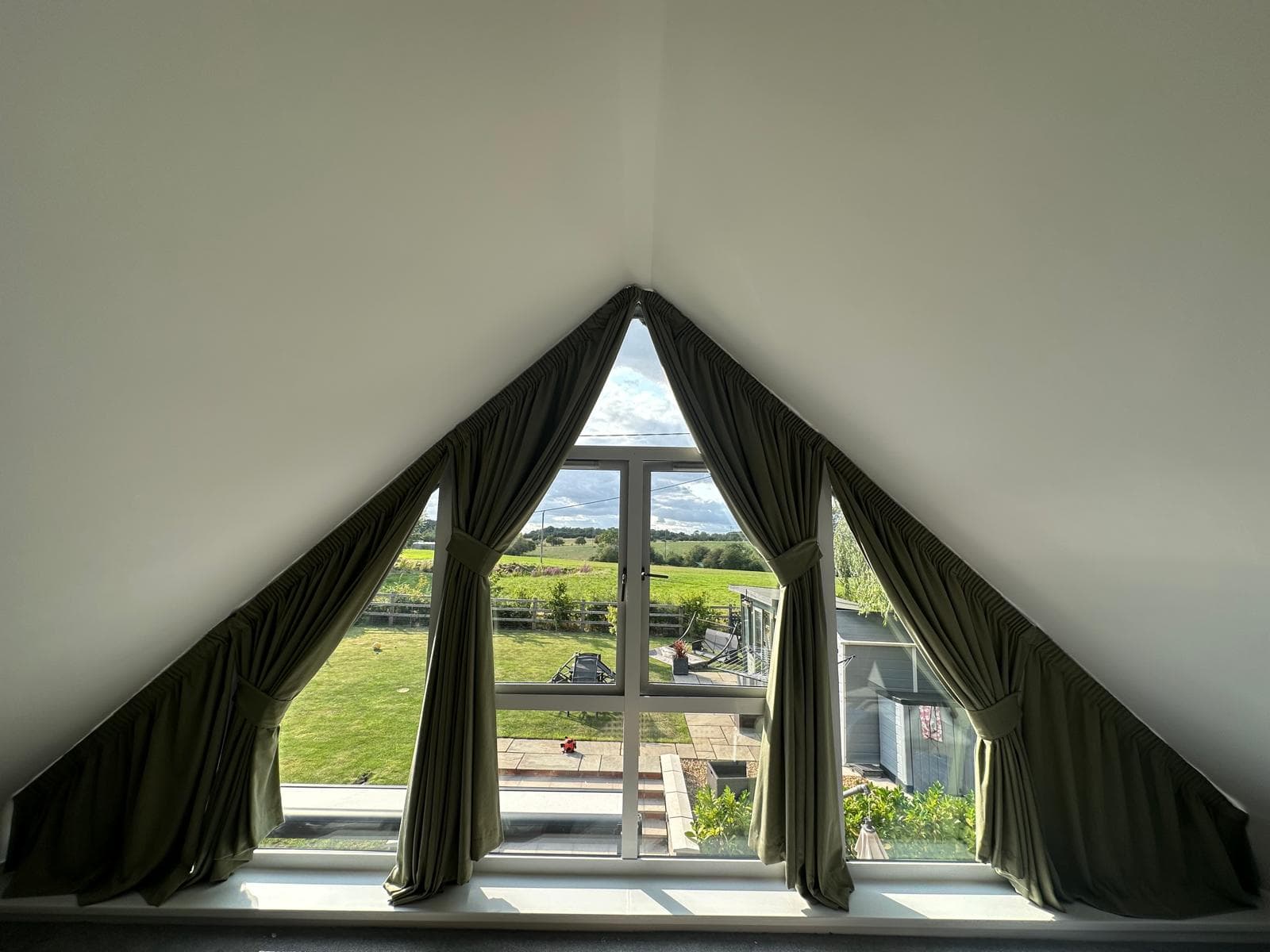
01 / The details
Match the cloth, or introduce a contrast
Matching tiebacks use the curtain fabric to create a continuous, calm appearance. The eye follows the sweep of the folds rather than a separate accessory. They can be especially effective where a strong window shape or a patterned curtain already provides the focal point.
A contrasting tieback introduces another colour or texture. It might echo a cushion, a painted wall or a detail in the weave. Contrast need not be bold: a tonal change from warm ivory to oat, or from olive to a deeper green, can make the shape more legible without dominating the room.
Review the tieback against the curtain in daylight and in the lighting used in the evening. A fabric with a sheen can look much lighter across the curve of a tieback than on the flat curtain. The reverse may also be exposed, which makes the lining colour part of the composition.
02 / The details
Individually made for the curtain
Apex can make tiebacks individually to suit the curtain and the intended shape. Length, width, fabric direction and the way the ends meet the hook should be considered together. A small off-the-shelf tieback can pinch a full lined curtain, while an oversized one can disappear into a light, narrow panel.
For a patterned cloth, discuss where the motif will sit and whether paired tiebacks should mirror one another. For a plain weave, the cut and finish become more noticeable. Custom making also allows the scale to relate to a very long drop without simply enlarging every dimension.
The correct size is established around the dressed curtain, including lining and fullness. A measurement of the flat curtain width alone cannot determine the tieback length: the volume of the gathered folds and distance to the hook both affect the fit.
03 / The details
Find the position in the room
There is no universal hook height that works for every curtain. Start with the intended view, curtain drop, fullness and the window’s proportions. Holding the curtain in a trial position before fixing helps reveal whether the sweep feels balanced and whether the hem is being lifted or dragged.
A higher or lower tieback changes the curve of the fabric and which part of the glass is visible. Moving the hook further from the opening can draw more cloth towards the wall, but only if the curtain has enough ease. Pulling too far can distort the heading and strain the fabric or fixing.
On an asymmetric or apex window, identical hook heights do not necessarily create the most balanced result. Each panel may have a different drop or volume. The arrangement should be judged as a whole, with handles, doors, radiators and everyday reach taken into account. Hooks need secure fixing suitable for the wall and the force applied.
04 / The details
More view, with fabric still in the picture
Tying back a curtain gathers it at a chosen point. It does not remove the cloth from the window. The centre can open to the view while fabric remains over the upper slope and beside the tieback. This is particularly important for triangular glazing, where the top of a shaped curtain may stay attached along the angled track.
If your priority is to reveal every part of the glass, discuss that before the panels and track are designed. A decorative sweep and complete clearance are different outcomes. The visible coverage depends on panel layout, retained sections, hook position and how much cloth is gathered.
Explore the silhouette
The curtains return towards their hanging position. The agreed track, panel layout and overlap determine how much glass is covered.
Schematic only. This illustrates coverage, not the operation or dimensions of a particular installation.05 / The details
Dress the folds gently
Use the opening position demonstrated at installation. A shaped curtain may have fixed or retained sections, so do not pull the heading across a slope to imitate a straight curtain. The tieback should support the arrangement without lifting the curtain’s weight from its track.
- Open any travelling section as intended, then arrange the folds by hand from a comfortable position.
- Gather the fabric and lining together without twisting one layer around the other.
- Bring the tieback around the folds and secure its ends to the intended hook. Avoid tight knots or crushing the cloth.
- Ease the folds above and below the tieback so the sweep is relaxed and the hem hangs naturally.
- Check the curtain is clear of handles and doors. Release the tieback before closing a travelling panel.
06 / The details
A finishing detail that works every day
Tiebacks are optional. Some interiors suit a simple vertical stack with no accessory, while others feel complete with a soft gathered shape. Decide how often the curtains will be opened and whether the hook is comfortably reachable before choosing purely for appearance.
Keep loops and cords out of reach of young children and away from cots or climbing furniture. Avoid leaving a loose loop where it can be caught. If the hook loosens, stop using it until the fixing has been assessed.
Care for a fabric tieback according to its own construction and care guidance. Do not assume a lined or shaped tieback can be washed because the face fabric can. If regular use leaves a tight crease, ask about dressing or a more generous size rather than pulling the cloth harder.
A little more clarity
Your questions, answered
Can Apex make tiebacks to match my curtains?
Yes. Matching, contrasting and individually custom-made tiebacks can be considered as part of the curtain design, with size and position suited to the finished curtain.
How high should curtain tiebacks be fitted?
There is no single correct height. Trial the position against the curtain drop, fullness, desired sweep and visible glass before deciding where to fix the hook.
Will tying back apex curtains expose the entire window?
Not necessarily. Fabric can remain across the upper slopes and around the gathered sections. The panel layout, track and tieback position determine the view.
Made around your home
Let’s find the right finish
for your window.
A photograph, the shape of the room and the way you want it to feel. That’s where we begin.
Discuss your curtains Or call 0800 772 0367